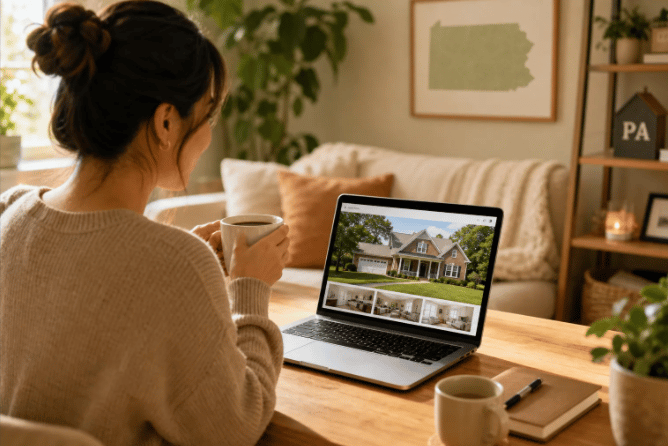
If you're asking what is the process for buying a home remotely in Pennsylvania, you're not alone, and you're not doing anything unusual. Professionals relocating from Texas, Florida, California, and elsewhere are closing on Pittsburgh-area homes they toured via FaceTime and signed for remotely. Agents and local market observers have noted a steady rise in out-of-state buyers making virtual purchases, particularly in the Greater Pittsburgh area. But Pennsylvania has specific legal requirements, county recording rules, and contractual deadlines that catch out-of-state buyers off guard if nobody prepares them in advance.
This is a plain-language breakdown of exactly how the process works, from choosing your local team through recorded deed. Teams like The Bingham Team at Howard Hanna have guided remote buyers through this process for years, using virtual walkthroughs, coordinated inspections, and confirmed remote closings. The steps below reflect that proven approach.
What is the process for buying a home remotely in Pennsylvania?
The short answer: it follows the same basic sequence as any Pennsylvania home purchase, but every step requires more deliberate coordination. You need the right local agent, a lender that can fund in your target county, a credentialed inspector who will be physically on-site, and a title company that has confirmed your closing documents qualify for remote online notarization and e-recording. Miss any of those pieces, and the process stalls, fast.
The sequence that makes remote buying work
Agent first. Pre-approval next. In-person inspection with live remote access during the contingency window. Then a confirmed remote closing process, verified with your lender, title company, and county recorder before you schedule anything. That order matters. Buyers who try to shortcut any step typically find themselves scrambling against a contractual deadline with no good options.
Start with a local agent who has done this before
This is one of the most important decisions in a remote purchase. Your buyer's agent is your eyes, ears, and judgment on the ground, and without a skilled one, every other step becomes harder and riskier.
What capable remote representation actually looks like: detailed video walkthroughs with honest assessments of both the property and the neighborhood, active coordination of inspectors and title companies, and real-time communication throughout the contingency period. This is not passive. It is daily, hands-on advocacy for a buyer who cannot be physically present.
The Bingham Team has been supporting out-of-state relocators for years. With a strong career sales record, FaceTime walkthrough capability across Greater Pittsburgh, and deep hyperlocal market knowledge, they bring the kind of ground-level expertise that makes a remote home purchase feel manageable rather than risky. That track record matters when you are making a six-figure decision from another state.
Get pre-approved and understand Pennsylvania's purchase agreement
Before the search begins, you need a pre-approval from a lender that can fund in the specific county where you are buying. Without it, sellers will not take your offer seriously, and your timeline unravels quickly. Lender capacity varies by market, and some lenders may face stricter local requirements, so confirm funding ability early.
Pennsylvania uses a state-specific Agreement of Sale with firm contractual deadlines that apply regardless of your time zone. The key ones for remote buyers: earnest money is typically due within five calendar days of a fully executed agreement, and the inspection contingency window is generally ten calendar days from that same date. Miss either deadline without a written extension, and you risk losing your deposit or waiving your inspection rights entirely. Your agent should walk you through every deadline the moment an offer is accepted.
Virtual tours and remote inspections: what actually works
Virtual tours give you a useful starting point for a virtual home purchase in Pennsylvania. They are not a substitute for a licensed inspector physically inside the property. For a remote purchase, the right approach is straightforward: hire a qualified, credentialed inspector to visit in person, while you join live via FaceTime or Zoom. Look for ASHI or InterNACHI membership, errors-and-omissions insurance, and at least 100 completed inspections. Ask the inspector to show you the roof, attic, foundation, electrical panel, HVAC, plumbing, and any signs of moisture in real time.
Remote buyers should also budget for targeted follow-up tests inside the contingency window. Radon testing runs $90 to $250, a sewer scope $100 to $300, and a termite inspection $50 to $150. A realistic total budget for the general inspection plus one or two specialized tests is $500 to $1,000. A virtual-only inspection is not equivalent to an in-person one, and no amount of camera quality changes that. Get someone physically in the building.
Remote closing in Pennsylvania: what the law actually allows
Pennsylvania's Act 97 of 2020 made remote online notarization (RON) permanent statewide. A Pennsylvania-commissioned notary, physically located in the Commonwealth, can notarize your closing documents via approved audio-video technology. The notary must use a Department of State-approved RON platform, not a general video call like FaceTime or Zoom.
RON identity verification requirements
Pennsylvania RON rules allow identity to be established through personal knowledge, a credible witness, or at least two identity-proofing processes. Your title company will confirm which method applies to your closing. The full audio-video session must be recorded and retained for a minimum of ten years.
E-recording and county-by-county rules
E-recording is accepted in 54 of Pennsylvania's 67 counties as of 2026, including Allegheny. But acceptance varies by document type even within participating counties. Allegheny County, for example, does not accept e-recorded corrective deeds, trust transfers, sheriff's deeds, or deeds taxable in multiple jurisdictions, those require paper submission. Confirm your specific document type with the title company before scheduling the closing, not after. Check the county recorder's office directly or ask your title company to verify, since participation and accepted document types can change.
Wire fraud precautions
Wire fraud targeting remote real estate buyers is real and well-organized. Scammers impersonate title companies and send "updated" wiring instructions at the last minute. Before wiring any funds, call the settlement agent using a phone number you obtained independently. Read back every digit of the routing and account number, and verify receipt immediately after. Do not act on emailed wire instructions alone. Ever.
Start your remote Pennsylvania home purchase the right way
Understanding what is the process for buying a home remotely in Pennsylvania comes down to one principle: coordination has to happen before you need it, not after a deadline hits. Agent first. Pre-approval confirmed for your target county. An in-person inspector on-site while you watch live. A title company that has already verified your documents qualify for RON and e-recording. That is the process that works.
If you are planning a Pittsburgh-area purchase from out of state, reach out to The Bingham Team before the search starts, not after. They handle the full remote process, from first virtual walkthrough through recorded deed, with the local knowledge and verified process to back it up. Contact the team directly to get started.