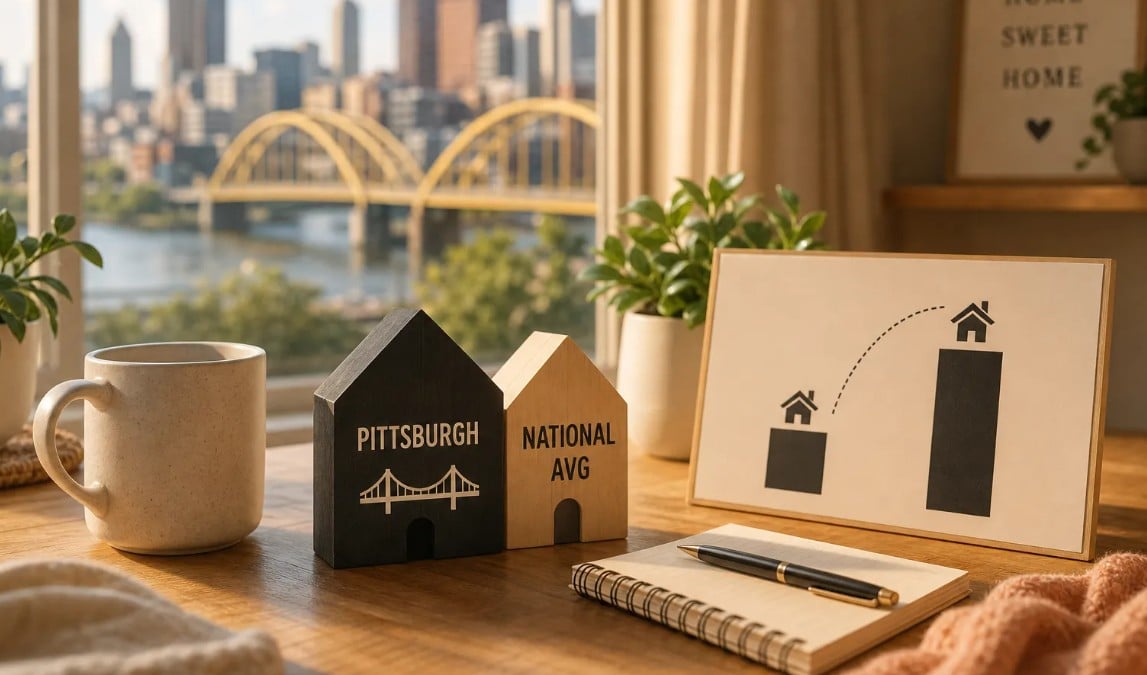
Pittsburgh's median home sale price sits roughly 45% below the national median in 2026. That single number tells you more about this market than most articles will bother to explain. It's not a sign that Pittsburgh is lagging. It's a structural feature of a market where prices are grounded in real demand, not speculative heat, and when you look at how Pittsburgh home prices compare to the national average across every relevant metric, the case for this market gets stronger, not weaker.
The Bingham Team tracks these figures closely across Allegheny County and the broader metro. The data backs it up: Pittsburgh offers genuine buying power in a national market where affordability has become the exception. The gap is real and significant, and it has meaningful implications for anyone buying, selling, or investing here in 2026.
Pittsburgh home prices vs. national average: what the medians actually show
Pittsburgh's metro median sale price sits at approximately $239,000 as of mid-2026, based on Zillow's Pittsburgh home-values report through late spring. Allegheny County's median lands slightly higher at $247,000, according to Q1 2026 county-level reporting from the Western Pennsylvania MLS. The median list price runs closer to $271,667, that's what sellers are asking, not what homes are actually closing for. Homes are going pending in roughly 8 days, per the same Zillow market report. This is not a slow, discounted market. Demand is real.
The national median sale price for Q1 2026 was $403,200 for new single-family homes, according to the U.S. Census Bureau new residential sales data, while NAR puts the existing-home median at approximately $404,600 for the same period. National asking prices touch $430,000 on platforms like Realtor.com June 2026 list-price data. The variation between sources comes down to whether they're measuring new homes, existing homes, list prices, or closed sales. For an apples-to-apples comparison using closed sale prices, Pittsburgh's $239,000 against the national $403,200 is the cleanest read.
Pittsburgh is roughly 40, 45% below the national median sale price. Using a widely cited comparison that measures Pittsburgh's $237,833 median against the national $429,526 figure, the gap works out to 44.6%. Even using conservative estimates on both ends, Pittsburgh buyers are entering a market where homes cost less than half of what comparable purchases run in cities like Boston, Seattle, or major California metros. That's not a rounding error.
Why Pittsburgh prices haven't been bid up like the rest of the country
A significant portion of Pittsburgh's housing stock is 45 to 105 years old. Older inventory caps price floors across many neighborhoods because buyers are factoring in the cost of updates, maintenance, and energy efficiency gaps. Pittsburgh is also landlocked, which limits peripheral development and keeps the supply of modern new construction tight. The result is a market where the typical home is older, smaller, and priced accordingly.
Pittsburgh's price-to-income ratio stands at 3.07, compared to the national average of 5.08, according to affordability analysis from the market data underlying this report. That means local incomes have historically anchored what buyers can borrow and what sellers can reasonably expect. Pittsburgh residents spend about 27.4% of their income on housing, while the national share sits at 44.6%. Pittsburgh is one of only a handful of major metros where median-income earners can buy without exceeding the recommended 30% housing-cost-to-income threshold.
Pittsburgh's 5.2% year-over-year appreciation through Q1 2026 outpaced the national average, but without the volatility that hit coastal markets. While cities like San Francisco and Austin saw sharp corrections after the 2021, 2022 run-up, Pittsburgh climbed steadily. Current Q1 2026 regional projections point to 3, 6% growth through the end of the year. That's a stability story, not a stagnation story.
Pittsburgh vs. national home prices: how the affordability gap holds up neighborhood by neighborhood
The neighborhood breakdown shows real range within the affordability story. Oakmont sits around $278,000 and represents solid mid-range value. Lawrenceville comes in near $298,000 and is one of the fastest-moving markets in the city, averaging just 12 days on market with 7.3% year-over-year appreciation. Mt. Washington is at $312,000, up 8.1% year-over-year, and typically moves in about 15 days. These aren't overlooked pockets; they're competitive neighborhoods with genuine buyer demand. All figures are sourced from Q1 2026 neighborhood-level data via the Western Pennsylvania MLS.
At the premium end, Shadyside's median lands around $362,500 and Squirrel Hill sits near $385,000 for the broader neighborhood, with Squirrel Hill North home values on Zillow skewing significantly higher depending on the specific property. Fox Chapel, the clearest luxury tier in Allegheny County, carries a median of $595,000. Even at the top of Pittsburgh's market, those numbers remain a fraction of what comparable neighborhoods cost in Boston, Seattle, or any major California metro. For buyers focused on the upper tiers, our Pittsburgh Luxury Homes: The 2026 Buyer's Neighborhood Guide breaks down the luxury submarkets and what to expect.
What this means if you're buying or selling in Pittsburgh in 2026
Allegheny County is currently sitting at 1.8 months of inventory. That's a seller's market. Pittsburgh's affordability advantage doesn't mean buyers can take their time and negotiate from a comfortable position. Homes in desirable zip codes move in days. The value is genuine, but so is the competition. Buyers who come in pre-approved, clear on their target neighborhoods, and ready to move close deals. Those who don't, lose them.
For buyers: what the Pittsburgh vs. national home price gap actually means at the offer table
For buyers relocating from higher-cost metros, the math is compelling. A household priced out of comparable neighborhoods in Denver or Nashville may find real equity-building opportunity here. The 44.6% gap against the national median represents meaningful financial leverage, particularly given Pittsburgh's 5.2% appreciation rate recorded through Q1 2026. If you're working with a local agent who tracks street-level data, current inventory, neighborhood-specific days on market, and recent closed comps, you'll be positioned to move quickly and price offers accurately in a tight market. If you're planning a move, our Moving to Pittsburgh, PA: The 2026 Relocation Guide covers logistics and neighborhood fit for newcomers.
For sellers, local appreciation trends are working in your favor. Pittsburgh's steady climb, without the boom-and-bust cycle that affected other markets, means equity gains here have been durable. With 1.8 months of inventory and homes moving in under two weeks in competitive zip codes, well-priced listings aren't sitting. Sellers who price to the data rather than to optimism are seeing strong list-to-sale ratios and limited time on market.
The bottom line on Pittsburgh home prices vs. the national average
When you put Pittsburgh home prices vs. the national average side by side, the picture is consistent: Pittsburgh runs 40, 45% below the national median, and that gap is backed by structural fundamentals. An older housing stock, income-anchored buyer demand, limited new construction, and a landlocked geography that prevents the kind of sprawl that inflates prices elsewhere all contribute. It's not a weakness. It's why this market has stayed stable while others corrected sharply.
For buyers, this is a window into a market with real value and a real appreciation trajectory. For sellers, the local trend line is moving in the right direction. In both cases, decisions should be driven by neighborhood-level data, not headlines from overheated coastal markets.
If you want to understand exactly where you'd land in Pittsburgh's market, what your budget buys and which neighborhoods fit your goals, work with someone who tracks these numbers at the street level. The Bingham Team has been helping buyers and sellers navigate Allegheny County for more than two decades. See our Frequently Asked Questions, Pittsburgh Real Estate or Reach out and get a clear picture of where you stand.