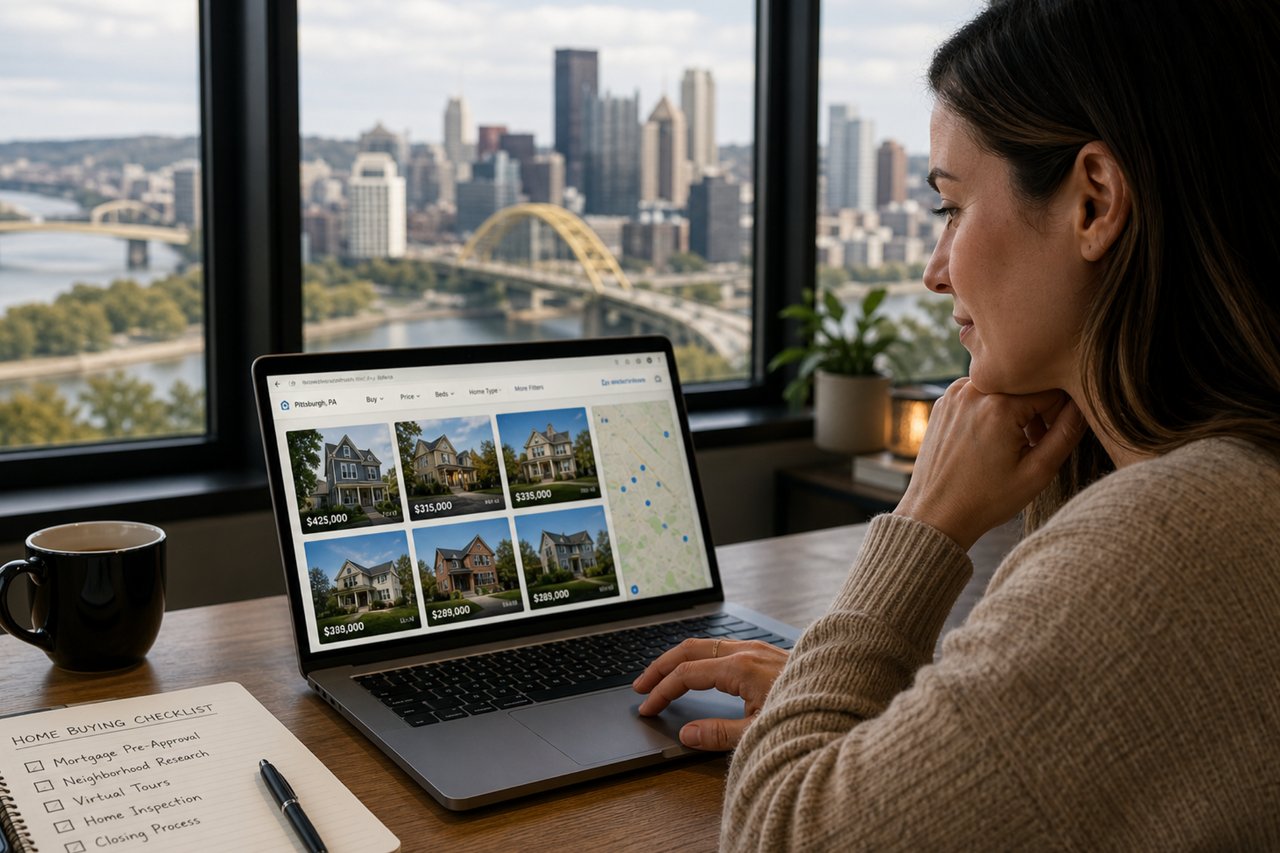
Buying a Pittsburgh home out of state is more common than most people realize, and more manageable than most people fear. Buyers are purchasing Pittsburgh homes without ever setting foot inside them. The technology exists, the legal framework supports it, and the right local team makes the gap between your current zip code and your future one surprisingly workable.
That said, the fears are real. Paying too much for a house you've only seen on a screen. Missing a foundation crack that shows up two months after closing. Picking a neighborhood that looks fine on Google Maps but doesn't fit how you actually live. These aren't irrational worries. They're the right things to be thinking about.
The Bingham Team has worked with buyers relocating from Texas, Florida, and beyond, running FaceTime walkthroughs, coordinating inspections, and guiding people through closings completed without ever boarding a plane. This guide covers exactly how that process works: neighborhoods, mortgage prep, virtual showings, inspections, and closing. Read it front to back before you do anything else.
Why Pittsburgh Makes Sense for Out-of-State Buyers Right Now
 The numbers are straightforward. Pittsburgh's metro median sale price sits around $250,000 in 2026, and the city itself hovers near $213,000. Buyers coming from Austin, Miami, or the Bay Area are regularly surprised by what that budget gets you: a real house with a yard in a real neighborhood, not a condo with shared laundry. For additional market context, see a recent Pittsburgh housing market 2026 overview.
The economic base here is stable and diversifying. Major healthcare systems, Carnegie Mellon University and the University of Pittsburgh, and a growing tech sector have anchored the local economy for decades. These aren't boom-and-bust industries. For relocators weighing where to put down roots, that stability matters as much as the price tag.
What's Pulling Relocators to Pittsburgh in 2026

 The value comparison is hard to argue with. Lawrenceville, one of the city's most sought-after urban neighborhoods, runs $273,000 to $392,000. Mount Washington, with its downtown views and short commute, sits around a $117,000 median. Squirrel Hill and Shadyside start around $306,000 and climb from there. These are real neighborhoods with strong infrastructure, not trade-off choices. If you're focused on young-professional lifestyle choices, consult a guide to the best neighborhoods in Pittsburgh for young professionals to refine your shortlist.
Buyers from high cost-of-living states often find they can buy more home here, reduce their mortgage significantly, and maintain quality of life. That math is what's driving the volume of out-of-state interest in the Pittsburgh market right now.
What the Remote Buying Process Looks Like From End to End
The process follows a clear sequence. Most remote purchases move through these steps in order:
1. Narrow down a neighborhood shortlist based on lifestyle and budget
2. Get mortgage pre-approval from a Pennsylvania-licensed lender
3. Schedule virtual showings with your local agent
4. Submit an offer with the right contingencies in place
5. Hire a local inspector with experience on Pittsburgh-area homes
6. Close remotely via digital or mail-away process
 Each step builds on the last. Note that some steps, particularly lender conversations and neighborhood research, can run in parallel. When you understand the full sequence before you start, the process stops feeling like a risk and starts feeling like a project. For a practical primer on buying property out of state, use that resource to frame legal and logistical considerations early.
Family-Friendly Suburbs vs. Walkable City Neighborhoods
The South Hills suburbs, specifically Peters Township, Upper St. Clair, and Mt. Lebanon, offer top-ranked school districts, newer housing stock, and quiet residential streets. Mt. Lebanon's school district millage runs about 30.95 mills, reflecting the community's investment in its schools. These areas suit families who prioritize education rankings and space over walkability scores.
The East End city neighborhoods tell a different story. Squirrel Hill and Shadyside are dense, walkable, and diverse, with strong community institutions and reliable access to downtown. Lawrenceville skews younger, with an arts and food scene that appeals to professionals relocating without kids. Neither bucket  is better. They serve different lives. For additional neighborhood rankings and resident insights, consult Niche's Pittsburgh neighborhood listings.
How to Evaluate Commute, Safety, and Schools Remotely
Google Street View is your first tool, not your last. Walk the block virtually, check the condition of neighboring homes, and look at the street context. Then go to Niche or GreatSchools for district data, the municipality's public crime dashboard, and Google Maps for commute mapping to your workplace. Used together, these resources can replicate much of an in-person visit, though not everything a physical trip would reveal.

 What they can't fully replace is a conversation with a local agent who actually works in these neighborhoods. The Bingham Team operates across Peters Township, Upper St. Clair, Mt. Lebanon, Shadyside, South Side, and more. A short call with a local agent can substantially reduce the need for multiple in-person visits and surface neighborhood details you won't find on any dashboard.
What Price Ranges Look Like Across Pittsburgh's Top Areas
Budget by neighborhood before you start shortlisting. Mount Washington delivers the most affordable entry point in the city at roughly $117,000 median. Lawrenceville runs $273,000 to $392,000 depending on the block. Squirrel Hill and Shadyside start around $306,000. South Hills suburbs like Upper St. Clair trend higher, reflecting school district demand. Price per square foot swings dramatically between a Lawrenceville row house and an Upper St. Clair colonial, so set your budget by area before you fall in love with a listing.
Getting Mortgage-Ready Before You Start Touring Homes
Out-of-state buyers consistently underestimate how different their mortgage situation is. The pre-approval process is not the same as it is for a local buyer, and finding that out after you've found a home is the wrong time to learn it.

 The most important rule: your lender must hold a Pennsylvania license, as required by the Pennsylvania Department of Banking and Securities. Your current state lender may not have it. Many out-of-state buyers assume their existing banking relationship transfers, it often doesn't, and smaller lenders frequently don't operate across state lines. Start lender selection early and confirm Pennsylvania licensure before anything else.
What Lenders Need From Out-of-State Buyers Specifically
 Standard documentation applies: pay stubs, W-2s for two years, bank statements, and asset documentation. Relocating buyers add one more layer. If you're moving for a new job, the lender requires a non-contingent job offer letter or transfer documentation showing your confirmed salary in Pittsburgh. Lenders treat employment stability as a higher risk factor for relocators, and they underwrite accordingly. Have this documentation ready before your first lender call.
Why a Strong Pre-Approval Matters More When Buying Remotely
In a competitive market, listing agents evaluate the buyer behind the offer. A pre-approval letter from an unlicensed lender or one without proper documentation signals a risky transaction. A clean, fully documented pre-approval from a Pennsylvania-licensed lender tells the seller's side that this deal will close. When you're submitting a remote offer, that signal matters more than it would in person.
Once pre-approval is in hand, the showing process begins, and that's where virtual tools do the heavy lifting.
How Virtual Tours and Sight-Unseen Offers Work in Pittsburgh
 A FaceTime walkthrough done right covers more than you'd think. The question isn't whether you can evaluate a home remotely. It's whether your agent knows how to run the walkthrough so you actually can. The Bingham Team conducts FaceTime walkthroughs as a standard part of its remote buyer process, not as a workaround, but as a structured service with a specific agenda.
What a Real FaceTime Walkthrough Covers (and What to Ask)
Before the call, ask your agent to cover these specific items:
- Basement moisture signs, look for efflorescence, staining, and sump pump condition
- HVAC age and condition, including the furnace, AC unit, and filter housing
- Roof visibility from any accessible vantage point outside
- Water heater age and fuel type
- Electrical panel type, Federal Pacific and Zinsco panels are red flags
- Lot context: neighbor proximity, grade, and drainage toward or away from the foundation
- Street context and exterior condition, documented on video
Get the agent walking outside, not just inside. A good agent running this walkthrough covers these without being prompted. If they don't, that tells you something.
Making a Competitive Offer on a Home You've Never Walked Through
Structure the offer with an inspection contingency, a financing contingency, and an escalation clause if inventory is tight. The inspection contingency is your primary protection when buying without an in-person visit, it gives you the right to negotiate or walk away based on findings. In many cases, Pittsburgh sellers on well-priced listings are familiar with out-of-state offers, and a sight-unseen offer backed by a clean pre-approval and standard contingencies is not unusual. That said, seller receptiveness varies by price point and market conditions, so lean on your agent's read of the specific listing.
Coordinating Inspections and Vendors When You Can't Be There
You won't be standing in the corner during the home inspection. That's fine. What matters is who is there in your place and what you do with the report afterward.
Pittsburgh has significant older housing stock. Many homes in the city and inner-ring suburbs were built in the early to mid-1900s. The inspector you hire should have direct experience with that vintage: knob-and-tube wiring, clay sewer lines, older foundations, and wet basements are all common findings. Confirm that your inspector holds an InterNACHI or ASHI certification and has logged time on Pittsburgh-area properties specifically.
Hiring a Pittsburgh Home Inspector You've Never Met
 Home inspections in Pittsburgh typically run $300 to $600 for a standard single-family home, with many falling in the $350 to $475 range for homes under 2,500 square feet, though pricing varies, so get a few quotes before committing. For current local estimates on inspection pricing, review resources on home inspection costs in Pittsburgh and a local inspector's perspective on inspection value and pricing. Always add radon testing, which is standard practice in the region. Ask in advance whether the inspector allows remote participation via FaceTime during the inspection itself; some do, and walking through it live with your agent present on-site gives you a real-time read on findings rather than waiting for the written report.
How a Local Agent's Vendor Network Makes This Manageable
Out-of-state buyers don't have a trusted plumber or contractor on call in Pittsburgh. An experienced local agent does. The Bingham Team's vendor network gives remote buyers direct access to vetted professionals for inspection follow-up quotes, pre-close repair negotiations, and post-close service needs. A local agent with established relationships knows who shows up, does the work right, and charges a fair price; that's a different experience than a national relocation platform matching you with whoever happens to be available.
Buying a Pittsburgh Home From Out of State: Closing and Costs
Pennsylvania's transfer tax structure catches out-of-state buyers off guard regularly. The difference between buying inside the City of Pittsburgh and buying in the surrounding county municipalities is not minor. It's meaningful enough to affect your budget.
What Out-of-State Buyers Actually Pay at Closing in Allegheny County

 The state realty transfer tax is 1% of the sale price, per the Pennsylvania Department of Revenue. Local transfer taxes add on top of that. Inside the City of Pittsburgh, the local rate is 4%, bringing the total to 5%. In most other Allegheny County municipalities, the local rate is 1%, making the total 2%. That's a 3% difference on the same purchase price. On a $300,000 home, that's $9,000. Allocation between buyer and seller is negotiated in the agreement of sale, but buyers should budget for their share regardless. For county-level property tax context, review Allegheny County property tax rates and the county's 2026 tax bulletin for planning accuracy.
Beyond transfer taxes, expect title insurance, recording fees, and lender closing costs. Total closing costs for buyers in Pennsylvania typically land between 2% and 5% of the purchase price, depending on loan type and municipality. Run the full number before you go under contract.
How Remote Closing Works in Pennsylvania

 Pennsylvania permanently legalized remote online notarization under Act 97 of 2020. Most title companies now offer fully digital closings via a secure video session where identity is verified, documents are signed electronically, and the notary applies their seal in real time. Some lenders still prefer wet signatures and a mail-away process, where documents are printed, signed at a local notary, and shipped to the settlement agent. Both paths are legal and functional.
 One requirement that surprises remote buyers: the Certificate of Residence. As required by the Allegheny County Recorder of Deeds, this typed form, embedded in or attached to the deed, specifies the owner's tax mailing address with a full, verifiable USPS address including zip code. Deeds are rejected without it. Your title company handles preparation, but your agent should flag it early so nothing delays recording. The Bingham Team coordinates this as part of the standard closing timeline; for the county's official guidance, see the Allegheny County Certificate of Residence instructions.
The Process Works When You Work It Correctly
Buying a house in Pittsburgh from another state is not a gamble. It's a process. Shortlist neighborhoods with a framework, not a feeling. Get pre-approved by a Pennsylvania-licensed lender before you start touring. Use FaceTime walkthroughs to evaluate homes with the same rigor you'd apply in person. Protect yourself with the right contingencies. Hire a local inspector who knows older housing stock. Understand what you're paying at closing before you go under contract.
Every one of these steps is manageable when you have the right local team running it with you. The Bingham Team has closed transactions for buyers who completed the entire process without visiting Pittsburgh once, and the team's depth of experience with remote home buying in Pittsburgh means you're not their first call on any of this. That's not a team that figures the process out as it goes.
If you're relocating to Pittsburgh and want a team that has run this exact process dozens of times, reach out to The Bingham Team at Howard Hanna. The first conversation answers more than you'd expect.